Rob Cullen artist, writer, poet. Rob runs “Voices on the Bridge” a poetry initiative in Wales. Walks hills and mountains daily with a sheep dog at his side.
*Pen y fan is the highest mountain in South Wales.
…
In February 2020 a storm hit South Wales. A month’s amount of rain fell in two days. Pontypridd town was flooded, and so many homes and shops were devastated by the floodwater. Three Bridges were closed — thankfully not the Victoria Bridge, which carries one of the main road arteries connecting the town to the motorway network. Shops have moved to vacant premises which are above the flood zone. It’s a slow process. And even now many retail premises are closed, and the town has the feel of a place that is going through hard times and an unstoppable decline.
Homeowners who suffered the worst of the flooding were those whose homes had been built along the sides of the river, but sometime back had been flood-proofed and thought safe. Such was the scale of the flooding on this occasion, no flood-proofing stood a chance of holding the floodwaters back. It was a warning that, with climate change and the ominous reality that flooding on this scale in these narrow spate river valleys will become regular events, we had better be prepared and change so much of what we do.
Mountains stripped of trees by clear-felling so that the ability of the mountains to “hold” water and slow its movement to the river are seriously impeded; together with farm land left bear over winter so that there is a continuous erosion of soil and, again, no holding back of rain water. And everywhere the concretisation of large areas so that water just runs off even more swiftly into a river already gorged with flood.
The town is steadily pulling itself back together. I’m constantly amazed by the resilience folk are showing in the face of what has been two devastating blows, the flood and Covid19. But the struggle to survive the hardship life throws is at the heart of valleys people.
But like Covid19, the floods and extreme weather events, such as the floods of February 2020, have been a warningthat lifestyles and industry have to change. Its dismaying to hear of the call for a return to the old days, when the economy will get back to “normal” and the destruction of Earth continues. The announcements of the release of the vaccines has been accompanied by a call to return to normality. But what on earth does that normality mean? And at what price?
The floods that besieged Pontypridd, a small town in Wales have also been replicated all over the world. A flag is being waved. Sit up and take note.
And we wait for February’s rain whatever that will bring!
Rob Cullen artist, writer, poet. Rob runs “Voices on the Bridge” a poetry initiative in Wales. Walks hills and mountains daily with a sheep dog at his side.
Death comes easily. It is always there — always near, always close by waiting. In March 2020, I suffered heart failure and came close to death. I didn’t survive because of luck — although I was lucky. I lived because of the professionalism of medical staff in our local hospital’s Accident & Emergency Unit. I was discharged five days later after two operations and a defibrillator pacemaker. That wasn’t luck. I know that if I lived in another country without a National Health Service I would be dead — death would have had its way.
…
I listen to the news casts each day, hear the latest covid stats — the number of new cases and the number of dead. Occasionally I see photos of crowds of people celebrating, ignoring the risks and the consequences, and the following week the spike in the stats that follows as sure as night follows day. I muse on whether people place so little value on their lives that they are willing to place themselves at such great risk. It suggests to me a mass Russian roulette.
…
I avoid crowds or social events in which there will be a large gathering. I am an artist, writer, poet who enjoys my own company and isolation doesn’t weigh heavily on me. More importantly it gives me time. Time to write, time to read, time to play with pen and wash. And there is so much to see, feel, smell and breathe in. Every walk offers a richness of opportunity. I do not live in a town or a city but on the outskirts of a town in wooded countryside. On the last day of the year 2021 I think I am lucky.
Rob Cullen artist, writer, poet. Rob runs “Voices on the Bridge” a poetry initiative in Wales. Walks hills and mountains daily with a sheep dog at his side.
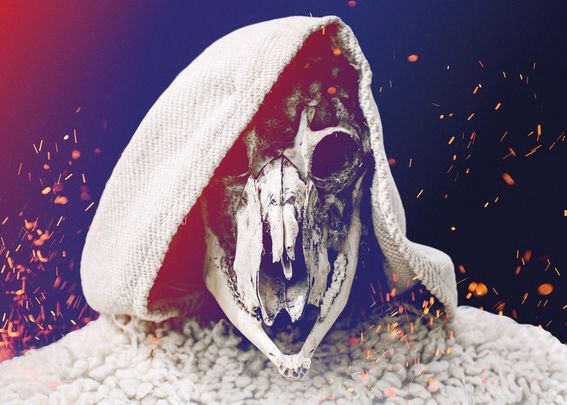
Puca are important mythological figures in the Celtic world. The Puca is a shape shifter. Puca are capable of good; but also capable, in their sinister form, of terrible life changing harm. Jung took a great interest in Celtic Mythologies particularly with stories about figures like the Púca in Irish folk tales. Púca is the Archetypal “Trickster”.
….
On rare occasions, the Púca was said to have the power of human speech. They used human words when they needed to lead a human away from harm. This is why humans were so afraid of Púcas: they could bring terrible misfortune, or they could save your life.When you met them, you weren’t ever sure which twist of fate to be ready for.
…
Coyote, Loki and Puca are all Tricksters.
…
And so the late President, Trickster in Chief — “All hail the Chief” — has attempted to emulate Coyote and reach the Sun and immortality and has failed. Trump has fallen as he must do! And like Coyote he must try again!
Rob Cullen artist, writer, poet. Rob runs “Voices on the Bridge” a poetry initiative in Wales. Walks hills and mountains daily with a sheep dog at his side.
unable to credit foto of the open market Pontypridd.unable to credit foto of the open market Pontypridd.
Pontypridd Town is a meeting place — it is also the place which all the characters in the poem are elderly residents, the place they grew up in, had fun, worked raised families and lived long lives.
…
The town is a meeting place, a meeting of three rivers and valleys where a large indoor market and open market have been established. The town is a bustling, busy, thriving, place of skullduggery and sharp deals; once a boom town, now a town that has seen hard times and looks a little down at heel. It could do with a little luck — my cheery elderly friends have seen it all — the ups and downs, a depression, a war — and came through it all with a cheerfulness that brings a smile when I think of them.
…
with thanks to Rhondda Cynon Taf library archives.
Pontypridd is a place of Easter and Summer Fairs — Danter’s Fairs that plied all the valley towns. Fairs that are the remnants of the old festivals to mark the solstice and the Christian calendar — the older context lost in the newer religious puritan revival’s disdain for such activities and as a result we have lost so much. Loss again…
…
My friends talked a lot about Danter’s fairs, a meeting place for the young. The Fair still comes to Pontypridd, rides that reflect the horror liked by this generation bread and buttered on online gothic terror. It’s a young persons pleasure. But it always was.
…
Covid has heightened not just the deaths of the elderly, but the loss of knowledge and memories of their lives and experiences. Memories that are unrecorded. We are unable to hand them on.
“Our lives are brief, a mere fluttering in time. So open the door wide and let the light in!”
So we cut the roses for your grave and let them rest on the wet grass — your life was a golden thing, hope filled and hope given to so many! You will never leave us.
In the early afternoon of Thursday 16th June 2016, after leaving a meeting with her local constituents, the 41-year old British Labour politician Helen Joanne Cox, a married mother of two young children, was chased down the streets of Birstall, England by a man intent on killing her, a killer who was patiently lying in wait. The man subsequently stabbed her, then shot her, and left her to bleed to death in a car park behind the local library.
…
Murder of an activist
…
Dress it up whichever way you want,
but what it breaks down to
is the senseless murder
of a woman by a man.
…
Senseless the loss.
Senseless the pain.
The resort to violence.
The resort to hate.
…
And the mindless murder
of a defenseless mother.
Whichever way it breaks down,
it’s male violence again.
…
A tribute to Jo Cox, MP, radical activist, mother of two.
Born 22 June 1974 murdered 16th June 2016.
Jo Cox was murdered by a far right white nationalist. A male.
…
“It’s not about creating an equal country, but it is about stopping the development of an underclass cut off from the rest of society.”
“Every decade or so, the world is tested by a crisis so grave that it breaks the mould: one so horrific and inhumane that the response of politicians to it becomes emblematic of their generation — their moral leadership or cowardice, their resolution or incompetence. It is how history judges us.”
In 1942 Juliette Greco, who has died this week, wrote in her autobiography that she and her sister were arrested by the Gestapo when she was sixteen, as her mother was active in the Resistance.
She was held in a small cell with a light permanently on, the usual sleep deprivation, before interrogation. She later wrote of her Gestapo interrogator “I will never forgive him” — “I know that I myself will fight until the last day of my life, against oppression, against intellectual terrorism, indifference and the denial of the only treasure that is worth preserving at all costs: the right to live as we choose, to think, to laugh, to give, to change, to love without fear whatever and whoever we love.”
Juliette Gréco, singer and actor, born 7 February 1927; died 23 September 2020.
In these times more than any other it is crucial — mandatory that all people oppose the politics of hate, and those who use violence and fear to promote hate to destroy our freedoms. Freedoms that have been hard won by our forebears and should now be cherished and not let go of easily!
My entire professional career of 37 years involved working with men who were violent, abusive and above all hated themselves — transferring that hate onto others as some kind of vindication of their worth, but like all bullies they make themselves feel alright by making other peoples lives miserable and not alright. Women and children, the most vulnerable are their victims — which tells you everything you need to know about them.
In the most extreme cases these men end up killing others whether its Jo Cox, MP in Birstall England or Heather Heyer in Charlottesville, Virginia and so many black lives because they are African Americans living in America. If our political leaders espouse or are sympathetic to those who project violence and hate within our society — we only have one choice. Vote them out! And to paraphrase Juliet Greco “I know that I myself will fight until the last day of my life, against oppression, against intellectual terrorism, and indifference”.
In the Cymer*, a gold eyed, grey white heron, stilted stands, where two rivers collide, commands the stream in its stiff eyed gleam, one peat whiskey brown, the other bottle green.
In the break and rush of an old fords remains, in its broken, rapid cold crackling ice water, among worn rounded scoured stones, Graylings, Queens of the Stream, gleam and glide, ride the current, sails aloft, hunting nymphs unseen.
In the slow wash of the silt drop zone, Goosanders dive through darkened swirls, hunting with sharpened eyes and beaks, while green necked mallards cruise serene, and gold skinned eels burrow roots of trees, lie glass-eyed grey through winters dream, and the Cymer’s deep dark pool, waits the run, of spawning silver spring Atlantic salmon.
Meanwhile horse eyed on the rivers path, blinkered people thumbing dull blue screens, walk their way, virtually oblivious to the snare.
*Afon — Welsh for river.
*Cymer — Welsh for the meeting of two rivers.
Afon Rhondda will be published in The Atlanta Poetry Review Spring 2020 Edition.
Rob Cullen artist, writer, poet. Rob runs “Voices on the Bridge” a poetry initiative in Wales. Walks hills and mountains daily with a sheep dog at his side.
“I used to think freedom was freedom of speech, freedom of the press, freedom of conscience. But freedom is the whole thing.” Everything flows – Yevgeny Grossman.
Something is breaking. It’s broken and won’t be the same. Life will renew, It won’t be the same, Something has broken, Nothing stays the same,
Rob Cullen artist, writer, poet. Rob runs “Voices on the Bridge” a poetry initiative in Wales. Walks hills and mountains daily with a sheep dog at his side.
Lightest pale yellow whitening, stretching away moorland grass, waving with the winds shift, slow gusts flow on the uplands plateau, distant raven specked black wheel, unhinged mating glide soars, in white grey clouded skies above the flat worn track.
Sinister Catherine wheeled turbines, hypnotically spin now, the latest transient seal that this margin land has no value, this hard edged landscape has no worth in any time, giant windmills that stud and transfigure the landscape, the latest scarring, killing the calm of the ghost road,
another sacrifice made of wilderness, and in this time a land of golden plovers and the call of curlews, nothing is sacred where sustainability is concerned. I walked wild on the high slopes when I was a child, in a sheep trailed playground on black curtained slopes,
too many lives unlived, cut short and each one, someon’s child, someone’s daughhter, someone’s son. For so many days I’d walk out on the ghost road, through summer, through winter snows,it was a place to breathe clear air, a place to be alone, a place to sketch Ffynon Saith’s black worn stone,
on the flat mountain plateau tops, where men once walked, with open still splayed nerves naked in white daylight, so many breathless men, taking the air on a Sunday, in the silence of a long year, in those hardest times, too many deaths, too many sudden unannounced leavings
a gathering place for the collection of remnants, of a day’s thoughts, a place to make sense somehow and of blanking out teenage doubts, a place of quietness, a place for forgetting, a place of dreams.
I wrote several years ago the following thoughts when constructing a long narrative history of my family titled — “An examination of time.”
Foto credit: un-copyrighted.
The photograph above is like many archive images of the South Wales Valleys in the heyday of its industrial past and the coal industries peak. It is not only familiar because it mirrors so many other photographs of the Rhondda. But the image is all too familiar because it is a photograph taken in 1910 of the village in which I was born in 1950, grew up and left in 1969. The landmarks familiar to me are there in the photograph.
And of course the year 1910 has great signifigance for anyone with a knowledge of the history of this place and the fight by mineworkers forjustice and a living wage in the Rondda and especially those from Tonypandy and Llwnypia. It is the year of the great strike that paralysed the mining industry and left families to strugge in penury and hunger. The subsequent levels of infant mortality and deaths of pregnant mothers was shocking and the highest in Britain. Perhaps the moment this reality struck home was when I discovered the record of my my grandfathers burial and grave to discover there were nine bodies interred.
However my interest in the village is not simply taken up by the associations it evokes or its unusual quality. My curiosity has also focused on the question of the location of the camera when the photograph was taken. The camera in some way had to be suspended high above the ground. However I know that no buildings of that height existed in that part of the valley at that time or since. So I am puzzled as to where the camera was positioned. It is a mystery.
And then there is the matter of the black speck (left of centre in the photograph) which on magnification becomes the form of a young girl running towards the camera. Or at least that was my memory of the photograph when I first viewed and examined it many years ago. I also seem to have elaborated an understanding from the time when I first came across. I rationalised that the photograph must have been taken near the No 6 shaft of Glamorgan Colliery, close to the old dram road tunneled beneath Ynyscynon Road, where the drams could be drawn by long steel cables to eventually spew the pit spoil onto the hilltop known as Mynydd Brithweunydd. Its other name was the “blood field”, purportedly the site of an ancient battlefield. (I wonder how many people know of the blood field and the reason that red bleed of a peat bog each Spring was given that name.)
I’d believed the terraced street to be seen was Ynyscynon Road and that somewhere out of view was my grandfather’s house. And that behind the camera also out of view was a row of tenement housing known as “rotten row” in which children might have friends but with whom they were forbidden to have any romantic attachment and on no circumstances was marriage to be entertained. Such was the fear of the poverty and disease that was believed to be rife there — so called “diphtheria and TB families”.
As mentioned previously the photograph was taken in 1910 the year of the miners strike and the Tonypandy Riots and five years before my mother’s birth. I wondered whether the running girl had seen the funeral procession of the Canadian soldier who had died in 1918 during the great influenza epedemic – which my mother had said was her first memory three years of age.
Or whether the girl herself had died during the influenza epidemic, or hopefully, had survived the poverty and hunger of those days. I wondered too whether she would have seen the great Chestnut tree outside the Ynyscynon Hotel, and the green where men played horseshoes — men including my grandfather. I remember as a child running through the dilapidated walls of the Pub’s old garden and sitting on the rotted out hulk of a great tree that had stood outside the Ynyscynon Hotel. But then it was pulled out and the green tarmacked to make a parking place.
Some two years I’d last looked at the photograph I found myself examining it again — touching base — reconnecting — with what exactly?
But on looking at it again I noticed that the image had changed. Or at least not that the image had changed but that my understanding of it had changed. The image does not in fact show Ynyscynon Road, Trealaw but Partridge Road, Llwynypia a differently named stretch of the same road further along the valley. And the pit shaft was not No 6 but an air shaft or some other kind of minor shaft.
Today in 2018 my understanding of the photograph has undergone another change. I have been researching the number of coking ovens operating in the massive Glamorgan Colliery complex. More specifically I was also researching the number of brickworks operating on the site and the number of women employed in the brickworks. My interest had been spurred by the fact that I was born in the house of a woman who had worked in the brickworks and whose lungs had been badly scarred by her employment there. But I have never been able to find photographic evidence or any detailed account of the numbers of women engaged in this physically arduous work. I found this reference today:
“The colliery (sic Glamorgan Colliery) was also famous for making bricks from clay mined at No 3 pit. Women using hand moulds produced 10,000 bricks per day.”
The photograph below clearly showing the stacks of the brick works in the huge industrial combine hat was the Glamorgan Collieries — locally known as “Scotch” colliery after the Scottish shaft sinkers that were brought in to do the task.
Foto credit: by kind permission of RCT Library Photo Archive
I also happened upon another photograph that I hadn’t seen before which was the reason for the change in the understanding of the original photograph that I began this post.
I had known that there had been heaps of pit waste higher than the houses of Ynyscynon Road. But I was genuinely shocked by the huge mound of pit waste in the centre of the photograph. I had never understood that the slag tip was so enormous. My grandparents’ house is hidden by it, as is my great aunts’ home. It then dawned on me how the original photograph had been taken it was from the heights of this mountain of waste.
However my understanding underwent another change the slag waste heap was not shown in another photograph as the same one taken in 2010. The puzzle of the original photograph remains unresolved.
The first photograph of this article also shows the hulk of buildings, brooding ominously above the village which, I as a child and into adulthood knew as the local hospital. But unbeknownst to me, in reality it had started as a “Workhouse”. In all the time that I had been living and growing up in the village I never heard it once mentioned, or reference made to the “Workhouse”. I know that people feared debt, destitution and homelessness — and the resulting “Workhouse” and all that it entailed. Perhaps that pervasive fear meant that people remained silent. One of the village characters was a Mr. Christmas who was left as a foundling on Christmas Day at the gates of the “Hospital” — he was give work as a kind of janitor and had accommodation in the Hospital where he lived and eventually died. His story was told to me as a child as I was curious about the stories of some of the odd characters who haunted the village like question marks without explanations…not once in relation to Mr. Christmas was there any mention of the workhouse although that was its function throughout my mother’s childhood up until the second world war.
Foto credit: by kind permission of RCT Library Photo Archive.
The removal of the tips that towered over my grandfather’s and his sister’s house taking place when I was a child. The viewing point where I suspect the first foto in this article was taken And above the village the Hospital stands, the exact same buildings as the “Workhouse” — there is nothing like fear, fear to silence people, the greater the fear the greater the silence!
Foto credit: by kind permission of RCT Library Photo Archive.
Rob Cullen artist, writer, poet. Rob runs “Voices on the Bridge” a poetry initiative in Wales. Walks hills and mountains daily with a sheep dog at his side.
Hi! my name is Sebastian (You can call me Seb!) ...welcome to my Blog. I'm a photographer from Worcester, Worcestershire, England. Thanks for dropping by! I hope you enjoy my work.